What Is 4D Radar? How Radar Technology Is Changing Autonomous Driving

 React
React

4D imaging radar is emerging as a key sensor technology for autonomous vehicles, combining long-range detection with high-resolution environmental perception and reliable performance in challenging weather conditions.
For a robotaxi to safely navigate its surroundings, simply detecting objects ahead is not enough. The vehicle needs to determine where an object is, how far away it is, whether it is moving, and in which direction it is traveling. It must also be able to do this in conditions such as heavy rain, fog, snow and darkness.
Several technologies are being developed to address these challenges. LWIR thermal cameras can detect heat signatures when visible light is limited, FMCW LiDAR can provide highly accurate three-dimensional information and object velocity data, while neuromorphic cameras can detect extremely small changes within a scene.
However, one fundamental challenge remains: autonomous vehicles need to perceive their surroundings at long distances, with high resolution and a low error rate, regardless of environmental conditions.
This is where 4D imaging radar comes into play.
Unlike conventional automotive radar, which primarily measures distance, horizontal position and relative speed, 4D imaging radar adds height information to the equation. The result is a much more detailed representation of the vehicle’s surroundings.
What Is 4D Radar?
Radar technology has been used in vehicles for many years. Adaptive cruise control, blind-spot monitoring and automatic emergency braking systems already rely on radar sensors.
Traditional automotive radar can estimate an object’s distance, horizontal position and relative velocity. 4D imaging radar adds the vertical dimension, allowing the system to determine an object’s position in three-dimensional space more accurately.
This produces a much denser radar point cloud than conventional radar systems.
The additional height information can be particularly valuable for autonomous driving. For example, a conventional radar may detect an object ahead, but determining its height can help the vehicle distinguish between an obstacle sitting on the road and an overhead structure that the vehicle can safely pass underneath.
How Does 4D Radar Create 3D Data?
4D radar still relies on radio waves. The sensor sends electromagnetic signals into the environment and analyzes the signals reflected back from surrounding objects.
The key difference is the advanced antenna architecture used by modern imaging radar systems.
Multiple transmitters and receivers can work together to provide significantly higher angular resolution. This allows the radar to better distinguish the horizontal and vertical positions of objects.
One of the key technologies behind this approach is MIMO, or Multiple Input Multiple Output.
By combining multiple physical transmit and receive antennas, a radar can create a much larger virtual antenna array. This effectively increases the number of channels available for processing and improves the system’s ability to determine the position of objects in both horizontal and vertical directions.
Companies such as Mobileye have developed next-generation imaging radar systems capable of processing more than 1,500 virtual channels. Its architecture also incorporates a dedicated radar processor with approximately 11 TOPS of processing capability, with radar data processed at up to 20 frames per second.
Meanwhile, Arbe’s 2026-generation radar technology increases the number of virtual channels to 2,304. At this level of density, the resulting radar point cloud can provide a significantly more detailed representation of the environment.
One of Its Biggest Advantages: Performance in Bad Weather
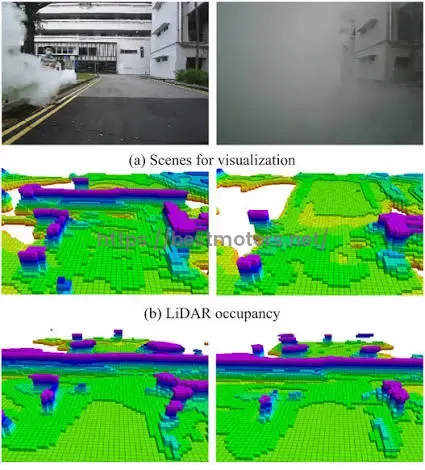
Cameras and LiDAR systems rely on optical signals and can therefore be affected by environmental conditions such as fog, heavy rain, snow, smoke and airborne particles.
Radar has an important advantage because it uses radio waves rather than visible light. This allows it to maintain a high level of performance in conditions that can challenge optical sensors.
4D imaging radar combines this inherent weather resistance with higher resolution, allowing it to provide much more detailed environmental perception than traditional radar systems.
Advanced imaging radar systems can reportedly achieve detection ranges of more than 300 meters. Arbe’s 2026 solution, for example, is designed to reach up to 350 meters.
Mobileye’s system can detect pedestrians, motorcycles and bicycles at distances of up to 315 meters, while potential hazards can be detected at distances of up to 230 meters.
Long-range perception is particularly important at highway speeds. The earlier an autonomous vehicle detects a potential hazard, the more time its control system has to evaluate the situation and perform an appropriate maneuver.
However, long-range detection also creates another challenge: the radar receives a large amount of unwanted signal information and environmental noise.
Advanced radar systems therefore need sophisticated filtering and object-tracking algorithms to distinguish real objects from noise.
Rather than relying on a single measurement, the system can track an object’s position and movement over multiple frames to determine whether it represents a genuine physical object.
Artificial intelligence and machine learning can further improve this process. Feeding radar signals or radar point clouds into deep-learning models is becoming an increasingly important area of development, particularly for more sophisticated object classification.
Will 4D Radar Replace LiDAR?
The rise of 4D imaging radar naturally raises an important question: if radar can generate high-resolution point clouds and directly measure velocity, does autonomous driving still need LiDAR?
The answer is not straightforward.
LiDAR uses laser pulses to create highly detailed three-dimensional representations of the environment. Radar, meanwhile, has major advantages in direct velocity measurement, long-range detection and operation in adverse weather conditions.
For this reason, the two technologies have traditionally been viewed as complementary rather than direct replacements for one another.
As imaging radar continues to improve, however, the distinction between the capabilities of the two technologies is becoming less clear.
A high-resolution 4D radar can combine long-range perception, detailed object detection and direct velocity measurement within a single sensor. This is prompting some automotive companies to reconsider how much LiDAR is required for certain levels of autonomous driving.
Nevertheless, solid-state LiDAR remains an important technology for applications requiring extremely detailed three-dimensional environmental mapping.
4D Radar Could Help Reduce the Cost of Autonomous Driving
Another major advantage of radar is its potential cost and packaging benefits.
Advanced LiDAR systems can be expensive, while radar sensors can generally be manufactured and integrated into vehicles more easily. Because radar uses radio waves, sensors can also be positioned behind certain vehicle components, including parts of the front bumper.
This provides automotive manufacturers with greater flexibility when designing sensor layouts.
However, 4D radar is not a simple or inexpensive technology.
As the number of antennas and the required processing power increase, the radar system becomes more complex. Higher data volumes also place greater demands on the vehicle’s computing architecture, communication bandwidth and processing latency.
Thermal management can become another consideration, particularly in electric vehicles where multiple sensors and high-performance processors need to operate within limited packaging space.
The Future of Autonomous Vehicles Will Depend on Sensor Fusion
The development of 4D imaging radar does not necessarily mean that cameras, LiDAR or thermal sensors will disappear.
Instead, the future of autonomous driving is likely to depend on sensor fusion.
Cameras, LiDAR, LWIR thermal sensors, neuromorphic cameras and 4D radar each have different strengths and weaknesses. Cameras can provide rich visual information, LiDAR can deliver highly detailed 3D geometry, thermal sensors can detect heat signatures, and radar can provide long-range perception and reliable operation in difficult weather conditions.
The autonomous vehicle of the future is therefore unlikely to rely on a single “eye.”
Its real intelligence will come from the ability to combine data from multiple sensors and interpret them together in real time.
As 4D radar continues to improve in resolution, range and processing capabilities, it could become one of the most important components of the next generation of advanced driver-assistance and autonomous driving systems.